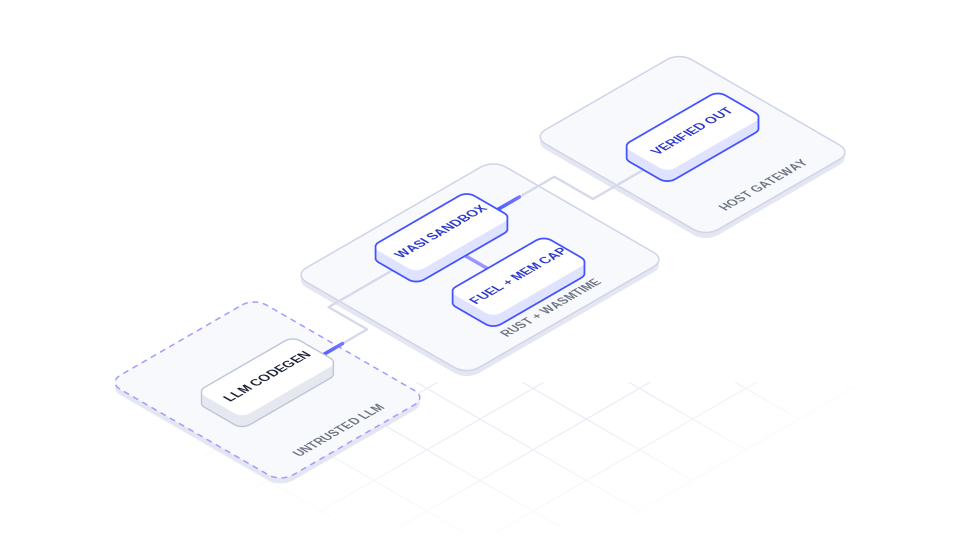
Where Python stops and Rust starts in AI systems
Python remains unbeatable for model experimentation, embeddings, and LangGraph orchestration. But once an AI product scales to thousands of concurrent tool calls, streaming gateways, or local desktop apps, GIL contention and memory overhead show up immediately.
Rust fills the systems gap: zero-cost abstractions, fearless concurrency, and tiny binary footprints—whether running cloud microservices or Tauri v2 local-first AI desktop apps.
- Never execute LLM-generated code directly on the host process—prompt injection or hallucinated imports can compromise secrets.
- Use Wasmtime fuel/epoch interruption to kill infinite loops deterministically.
- Expose only explicit, typed host functions to the sandboxed module.
Choosing between WASM sandboxes and microVMs
Not every workload needs a full Linux container. Picking the right isolation boundary keeps infrastructure bills low and response times instant.
| Runtime | Cold Start | Best Fit |
|---|---|---|
| Rust + Wasmtime | < 1 ms | High-frequency plugins, data transforms, JS/Python-lite tools |
| Firecracker / Docker | 100 ms – 2 s | Full Linux shell, arbitrary pip/apt packages, git repos |